

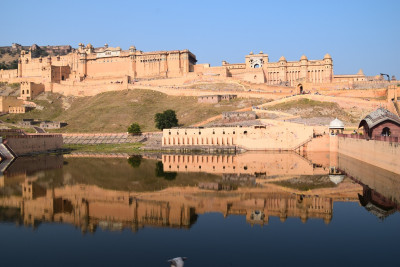
Amer Fort, also known as Amber Fort, is a majestic historical fortress located in Amer, near Jaipur in the Indian state of Rajasthan. It is one of the most iconic landmarks of Jaipur and a UNESCO World Heritage Site, renowned for its stunning architecture, rich history, and picturesque surroundings. Built primarily with red sandstone and marble, Amer Fort displays a unique blend of Hindu and Mughal architectural styles, reflecting the cultural fusion prevalent during its construction. The fort's imposing walls, bastions, and gates showcase intricate carvings, lattice work, and ornate detailing, making it a visual spectacle. The fort is strategically situated atop a hill, overlooking the Maota Lake, creating a mesmerizing reflection of its grandeur. It is divided into several sections, each serving different purposes such as residential quarters, public halls, and defensive structures. Amer Fort houses several notable attractions within its premises, including: Ganesh Pol: A magnificent gateway adorned with intricate frescoes and sculptures, leading to the main courtyard. Sheesh Mahal (Mirror Palace): A breathtaking hall embellished with thousands of tiny mirrors, reflecting light and creating a dazzling effect. The craftsmanship and detailing of the Sheesh Mahal are truly remarkable. Diwan-i-Aam and Diwan-i-Khas: The public and private audience halls, respectively, featuring ornate pillars, marble pavilions, and beautifully decorated ceilings where the royalty conducted official affairs and entertained guests. Sukh Mahal: A serene palace with cooling water channels and fragrant gardens, designed to provide relief from the scorching desert heat. Kesar Kyari Bagh: A geometrically laid out garden known for its saffron cultivation and stunning views of the surrounding landscape. Amer Fort has a rich history dating back to the 16th century when it was built by Raja Man Singh I, a trusted general of the Mughal emperor Akbar. Over the centuries, it underwent expansions and renovations under subsequent rulers, including Raja Jai Singh I and Sawai Jai Singh II, adding to its architectural grandeur and cultural significance. In the evenings, Amer Fort comes alive with a captivating sound and light show that narrates the history and legends associated with the fort, creating an enchanting ambiance for visitors. Overall, Amer Fort stands as a testament to the opulence and architectural brilliance of Rajasthan's royal heritage, attracting tourists and history enthusiasts from around the world to marvel at its splendor and explore its intriguing past.
Country
India
Best Time to Visit
January, February, March, September, October, November, December
Ideal Duration
n/a
Tourist Visa
You can apply for a tourist visa if you're visiting India for recreation, sightseeing, or to meet friends and relatives. You can also apply for a tourist visa if you're attending a short-term yoga program or medical treatment.
You can apply for an e-visa online.
Mandatory Documents:
1. Passport: Original passport valid for at least 6 months with at least 3 blank visa pages, plus a photocopy of the passport's data page.
2. Photographs: Two passport-size photographs (2x2 inches) glued to the visa application form as per instructions.
3. Visa Application Form: Fill out the Indian Government visa application form online at www.indianvisaonline.gov.in. Ensure your signature matches your passport signature and validate the data with a declaration signature at the bottom of page 2.
Additional Documents (Depending on Applicant's Situation):
• For Applicants of Indian Origin (Born Indian):
o Surrender Certificate or cancelled Indian passport copy or sworn affidavit.
• For Applicants of Indian Origin (Naturalized):
o First passport copy (if issued in India), Nationality Certificate, or sworn affidavit.
• Explanation for Birth in India (if not of Indian origin): Letter in English addressed to consular services explaining details and reasons.
• Parent of Indian Descent Born in France: Statement confirming no previous Indian passport or nationality.
• Joining Specific Organizations in India: Official invitation letter in a sealed envelope from the organization.
• Property Ownership Intention: Letter from Reserve Bank of India granting permission to acquire property and proof of property ownership in India.
• Minor Applicants: French "livret de famille" or birth certificate, ID proof of each parent, and travel authorization letter signed by both parents.
• Dual Nationality: Copy of the second passport.
• Applicants of Pakistani Origin: Reference form as per current nationality and additional documents based on current or previous nationality.
Declaration:
Certification: Acknowledgment of submitting a complete application and acceptance of the minimum processing time required.
Make sure to gather all necessary documents according to your specific situation and follow the guidelines closely to ensure a smooth visa application process. If you have any more questions or need further clarification on any of these requirements, feel free to ask!
Disclaimers
The above list of documents is the standard requirement for the visa application. The Embassy/Consulate/High Commission/Application Centres reserve the right to request additional documents for verification.
Travelspoc does not guarantee the outcome of any visa application. Decisions on visa applications are at the sole discretion of the respective Embassy/Consulate/High Commission.
The official website for applying for an Indian visa is:
