

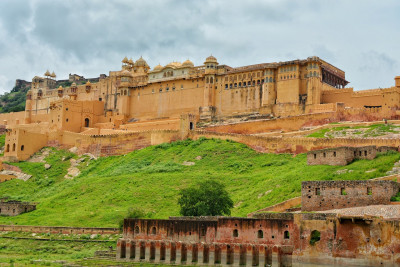
Jaigarh Fort, also known as the "Fort of Victory," is a formidable fortress located on the rugged Aravalli hills near Jaipur, Rajasthan, India. It is situated adjacent to the famous Amer Fort and offers breathtaking views of the surrounding landscape. Built in the early 18th century by Maharaja Sawai Jai Singh II, Jaigarh Fort is renowned for its robust military architecture. Constructed with red sandstone and reinforced with thick walls and bastions, the fort was designed to withstand enemy attacks. Its strategic location atop a hill provided a vantage point for surveillance and defense. Jaigarh Fort is home to several defensive structures, including ramparts, watchtowers, and cannon foundries. The most notable feature is the massive cannon named "Jaivana," which is believed to be the world's largest cannon on wheels. The fortifications reflect the military prowess and strategic foresight of the Rajput rulers. The fort boasts an advanced water harvesting and storage system, with extensive underground water reservoirs and tanks designed to sustain the needs of the occupants during times of siege. The presence of these water management structures underscores the importance of self-sufficiency in fortification design. In addition to its defensive structures, Jaigarh Fort also houses palatial quarters, royal apartments, and assembly halls. These sections offer insights into the lifestyle and grandeur of the Rajput royalty. The architecture of these buildings showcases intricate carvings, ornamental facades, and spacious courtyards. Jaigarh Fort is home to a well-preserved armory containing a vast collection of weapons, armor, and artifacts used by the Rajput warriors. Visitors can explore the armory and learn about the military history of Rajasthan. Additionally, there are museums within the fort premises displaying ancient manuscripts, coins, and other historical artifacts. One of the highlights of visiting Jaigarh Fort is the panoramic views it offers of the surrounding landscape, including the Amer Fort, Maota Lake, and the city of Jaipur. The elevated location provides visitors with stunning vistas, especially during sunrise and sunset. Apart from its historical and architectural significance, Jaigarh Fort is a popular tourist destination where visitors can engage in activities such as guided tours, photography, and leisurely walks along the fortifications. Overall, Jaigarh Fort stands as a testament to the valor, ingenuity, and architectural brilliance of the Rajput rulers of Rajasthan. It remains a symbol of the region's rich cultural heritage and attracts tourists and history enthusiasts from around the world.
Country
India
Best Time to Visit
January, February, November, December
Ideal Duration
n/a
Tourist Visa
You can apply for a tourist visa if you're visiting India for recreation, sightseeing, or to meet friends and relatives. You can also apply for a tourist visa if you're attending a short-term yoga program or medical treatment.
You can apply for an e-visa online.
Mandatory Documents:
1. Passport: Original passport valid for at least 6 months with at least 3 blank visa pages, plus a photocopy of the passport's data page.
2. Photographs: Two passport-size photographs (2x2 inches) glued to the visa application form as per instructions.
3. Visa Application Form: Fill out the Indian Government visa application form online at www.indianvisaonline.gov.in. Ensure your signature matches your passport signature and validate the data with a declaration signature at the bottom of page 2.
Additional Documents (Depending on Applicant's Situation):
• For Applicants of Indian Origin (Born Indian):
o Surrender Certificate or cancelled Indian passport copy or sworn affidavit.
• For Applicants of Indian Origin (Naturalized):
o First passport copy (if issued in India), Nationality Certificate, or sworn affidavit.
• Explanation for Birth in India (if not of Indian origin): Letter in English addressed to consular services explaining details and reasons.
• Parent of Indian Descent Born in France: Statement confirming no previous Indian passport or nationality.
• Joining Specific Organizations in India: Official invitation letter in a sealed envelope from the organization.
• Property Ownership Intention: Letter from Reserve Bank of India granting permission to acquire property and proof of property ownership in India.
• Minor Applicants: French "livret de famille" or birth certificate, ID proof of each parent, and travel authorization letter signed by both parents.
• Dual Nationality: Copy of the second passport.
• Applicants of Pakistani Origin: Reference form as per current nationality and additional documents based on current or previous nationality.
Declaration:
Certification: Acknowledgment of submitting a complete application and acceptance of the minimum processing time required.
Make sure to gather all necessary documents according to your specific situation and follow the guidelines closely to ensure a smooth visa application process. If you have any more questions or need further clarification on any of these requirements, feel free to ask!
Disclaimers
The above list of documents is the standard requirement for the visa application. The Embassy/Consulate/High Commission/Application Centres reserve the right to request additional documents for verification.
Travelspoc does not guarantee the outcome of any visa application. Decisions on visa applications are at the sole discretion of the respective Embassy/Consulate/High Commission.
The official website for applying for an Indian visa is:
