

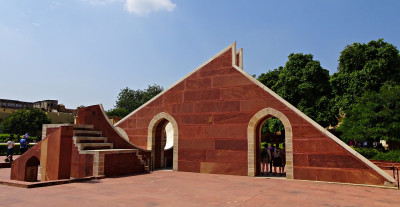
Jantar Mantar is a collection of architectural astronomical instruments located in various cities across India, notably in Jaipur, Delhi, Ujjain, Varanasi, and Mathura. These structures were built by Maharaja Sawai Jai Singh II, a Rajput king and astronomer, in the early 18th century. The term "Jantar Mantar" roughly translates to "calculation instrument" in Hindi, indicating its primary purpose as an observatory. Jantar Mantar was constructed with the primary objective of measuring time, predicting eclipses, and observing celestial phenomena such as the positions of stars, planets, and constellations. It served as a center for astronomical research and scientific experimentation during the medieval period. Each Jantar Mantar site comprises a unique collection of architectural instruments, meticulously designed to perform specific astronomical calculations and observations. These instruments include sundials, observatories, celestial globes, and specialized structures like the Samrat Yantra (Giant Sundial) and the Jai Prakash Yantra (Equatorial Sundial). Sundials are among the most prominent features of Jantar Mantar. These large, intricately carved structures use the position of the sun's shadow to indicate the time accurately. The Samrat Yantra, for instance, is a massive sundial with a precision of a few seconds. Jantar Mantar also houses observatories equipped with instruments like the Rashivalayas Yantra and the Dakshin Bhitti Yantra, which are used to track the movements of celestial bodies and calculate their positions relative to the Earth. One of the remarkable aspects of Jantar Mantar is the precise alignment of its instruments with the celestial bodies they are meant to observe. The structures are oriented according to the cardinal directions and calibrated to account for factors like the Earth's tilt and the observer's latitude. Jantar Mantar represents a significant milestone in the history of astronomy and scientific inquiry in India. It reflects the advanced knowledge and technological expertise of Indian astronomers during the early modern period and serves as a testament to the country's contributions to the field of astronomy. Today, Jantar Mantar sites are popular tourist destinations, attracting visitors from around the world who come to marvel at the ingenuity and historical significance of these astronomical observatories. Guided tours and audio-visual presentations are often available to provide insights into the functioning and significance of the instruments. Overall, Jantar Mantar stands as a symbol of India's rich scientific heritage and serves as a reminder of the country's longstanding fascination with the heavens above. It remains a cherished cultural landmark and a testament to human curiosity and ingenuity.
Country
India
Best Time to Visit
January, February, March, October, November, December
Ideal Duration
n/a
Tourist Visa
You can apply for a tourist visa if you're visiting India for recreation, sightseeing, or to meet friends and relatives. You can also apply for a tourist visa if you're attending a short-term yoga program or medical treatment.
You can apply for an e-visa online.
Mandatory Documents:
1. Passport: Original passport valid for at least 6 months with at least 3 blank visa pages, plus a photocopy of the passport's data page.
2. Photographs: Two passport-size photographs (2x2 inches) glued to the visa application form as per instructions.
3. Visa Application Form: Fill out the Indian Government visa application form online at www.indianvisaonline.gov.in. Ensure your signature matches your passport signature and validate the data with a declaration signature at the bottom of page 2.
Additional Documents (Depending on Applicant's Situation):
• For Applicants of Indian Origin (Born Indian):
o Surrender Certificate or cancelled Indian passport copy or sworn affidavit.
• For Applicants of Indian Origin (Naturalized):
o First passport copy (if issued in India), Nationality Certificate, or sworn affidavit.
• Explanation for Birth in India (if not of Indian origin): Letter in English addressed to consular services explaining details and reasons.
• Parent of Indian Descent Born in France: Statement confirming no previous Indian passport or nationality.
• Joining Specific Organizations in India: Official invitation letter in a sealed envelope from the organization.
• Property Ownership Intention: Letter from Reserve Bank of India granting permission to acquire property and proof of property ownership in India.
• Minor Applicants: French "livret de famille" or birth certificate, ID proof of each parent, and travel authorization letter signed by both parents.
• Dual Nationality: Copy of the second passport.
• Applicants of Pakistani Origin: Reference form as per current nationality and additional documents based on current or previous nationality.
Declaration:
Certification: Acknowledgment of submitting a complete application and acceptance of the minimum processing time required.
Make sure to gather all necessary documents according to your specific situation and follow the guidelines closely to ensure a smooth visa application process. If you have any more questions or need further clarification on any of these requirements, feel free to ask!
Disclaimers
The above list of documents is the standard requirement for the visa application. The Embassy/Consulate/High Commission/Application Centres reserve the right to request additional documents for verification.
Travelspoc does not guarantee the outcome of any visa application. Decisions on visa applications are at the sole discretion of the respective Embassy/Consulate/High Commission.
The official website for applying for an Indian visa is:
