

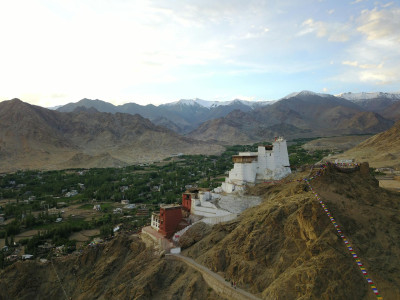
Leh is the largest town in Ladakh, situated at an altitude of approximately 3,500 meters (11,500 feet) above sea level. It serves as the administrative capital of the Ladakh region in the Indian state of Jammu and Kashmir. Here's a detailed description of Leh: Leh is nestled in the lap of the Himalayas, surrounded by rugged mountain ranges and barren landscapes. It lies along the banks of the Indus River, which flows through the region, providing a lifeline to the inhabitants. The town is flanked by snow-capped peaks and offers panoramic views of the surrounding valleys and mountains. History and Culture: Leh has a rich history that dates back centuries. It was an important stop along the ancient Silk Road, serving as a trading hub between India, Central Asia, and China. The town has been influenced by various cultures, including Tibetan, Indian, and Central Asian, resulting in a unique blend of traditions, art, and architecture. Leh's cultural heritage is reflected in its ancient monasteries, traditional festivals, vibrant markets, and warm hospitality of its residents. Monasteries and Historical Sites: Leh is home to several historic monasteries, each offering a glimpse into the region's spiritual and architectural heritage. Key monasteries include Hemis Monastery, Thiksey Monastery, Shey Monastery, and Spituk Monastery. These monasteries house priceless artifacts, religious relics, and stunning murals depicting Buddhist deities and legends. They also serve as centers of Buddhist learning and meditation. Tourist Attractions: Apart from monasteries, Leh boasts various tourist attractions, including Leh Palace, a former royal residence overlooking the town and the Stok Kangri range. The Old Town of Leh, with its narrow lanes, traditional houses, and bustling markets, offers a glimpse into the town's historical and cultural heritage. Shanti Stupa, a white-domed Buddhist stupa situated atop a hill, offers panoramic views of Leh town and the surrounding mountains. Adventure Hub: Leh is a paradise for adventure enthusiasts, offering a wide range of activities such as trekking, mountaineering, river rafting, mountain biking, and jeep safaris. The region's rugged terrain, high-altitude passes, and pristine landscapes attract adventurers from around the world seeking thrilling experiences amidst nature's splendor. Climate: Leh experiences a cold desert climate with low precipitation and wide temperature variations between day and night. Summers (June to September) are mild and pleasant, making it the peak tourist season, while winters (November to February) are harsh with temperatures dropping well below freezing. Overall, Leh is not only a gateway to the enchanting landscapes of Ladakh but also a destination rich in history, culture, and adventure, offering unforgettable experiences for travelers seeking to explore the Himalayan region.
Country
India
Best Time to Visit
April, May, June
Ideal Duration
n/a
Tourist Visa
You can apply for a tourist visa if you're visiting India for recreation, sightseeing, or to meet friends and relatives. You can also apply for a tourist visa if you're attending a short-term yoga program or medical treatment.
You can apply for an e-visa online.
Mandatory Documents:
1. Passport: Original passport valid for at least 6 months with at least 3 blank visa pages, plus a photocopy of the passport's data page.
2. Photographs: Two passport-size photographs (2x2 inches) glued to the visa application form as per instructions.
3. Visa Application Form: Fill out the Indian Government visa application form online at www.indianvisaonline.gov.in. Ensure your signature matches your passport signature and validate the data with a declaration signature at the bottom of page 2.
Additional Documents (Depending on Applicant's Situation):
• For Applicants of Indian Origin (Born Indian):
o Surrender Certificate or cancelled Indian passport copy or sworn affidavit.
• For Applicants of Indian Origin (Naturalized):
o First passport copy (if issued in India), Nationality Certificate, or sworn affidavit.
• Explanation for Birth in India (if not of Indian origin): Letter in English addressed to consular services explaining details and reasons.
• Parent of Indian Descent Born in France: Statement confirming no previous Indian passport or nationality.
• Joining Specific Organizations in India: Official invitation letter in a sealed envelope from the organization.
• Property Ownership Intention: Letter from Reserve Bank of India granting permission to acquire property and proof of property ownership in India.
• Minor Applicants: French "livret de famille" or birth certificate, ID proof of each parent, and travel authorization letter signed by both parents.
• Dual Nationality: Copy of the second passport.
• Applicants of Pakistani Origin: Reference form as per current nationality and additional documents based on current or previous nationality.
Declaration:
Certification: Acknowledgment of submitting a complete application and acceptance of the minimum processing time required.
Make sure to gather all necessary documents according to your specific situation and follow the guidelines closely to ensure a smooth visa application process. If you have any more questions or need further clarification on any of these requirements, feel free to ask!
Disclaimers
The above list of documents is the standard requirement for the visa application. The Embassy/Consulate/High Commission/Application Centres reserve the right to request additional documents for verification.
Travelspoc does not guarantee the outcome of any visa application. Decisions on visa applications are at the sole discretion of the respective Embassy/Consulate/High Commission.
The official website for applying for an Indian visa is:
